
Why your social media links keep getting flagged for review (and what to do about it)
Understanding why links get flagged for review
Social platforms manage millions of posts daily, and moderation at this scale relies heavily on automated systems that assess risk signals before content is shown to users. Links are pivotal in this process as they direct users off-platform and can expose them to potential security threats.
For these systems, one of the primary indicators of risk is your domain reputation. Platforms monitor whether your domain has been linked to spam, phishing, malware, or some shady sh… stuff in the past. Links from domains with a questionable or unclear history receive extra scrutiny. Honestly, it’s easier to flag your link instead of giving you the benefit of doubt.
Also, your tech stack plays a role. Unsecured connections leave users vulnerable to interception or malicious redirects, and URLs lacking HTTPS encryption often trigger warnings.
Obviously, your posting behavior also impacts trust. Accounts that share links in quick succession, frequently change destinations, or follow repetitive patterns look like they’re automated. Even legitimate businesses prompt reviews if their behavior resembles spam.
Some common reasons links get flagged
Frequent or repetitive posting
Seriously, posting the same link or message over and over in a short span just screams “low-quality automation.” On Twitter (rebranded to X), spam indicators include duplicate posts across accounts, link-only timelines, and aggressive follow-unfollow cycles.
Suspicious or unsecured URLs
Links that lack HTTPS, feature heavy tracking parameters, or involve multiple redirects reduce transparency. On Facebook and LinkedIn, generic shorteners and chained redirects often lead to lower distribution or manual reviews.
Redirects and affiliate cloaking
Let’s be real: those affiliate links that hide where you’re really going or hop through a bunch of domains are just trying to trick people. Numerous link-management sites highlight that masked URLs and sketchy domains will trigger spam filters immediately.
Low-quality or irrelevant destinations
Links that send users to ad-packed pages, deceptive offers, or totally unrelated content are more likely to be reviewed or deprioritized.
History of spam or automated behavior
New accounts or those with prior violations face stricter limitations. On LinkedIn, excessive connection requests or unsafe automation can trigger temporary restrictions. Similarly, on X, these patterns can reduce visibility without notification.
Bot-like behaviour
Bot-like behavior refers to activity patterns that mimic scripts rather than genuine user engagement. Instagram explicitly cautions that mass auto-liking, bulk following, and scripted comments violate platform rules and can lead to action blocks or shadowbans. Posting identical content across multiple accounts or using aggressive follow-unfollow loops often results in limited visibility. Employing official APIs for scheduling, varying actions, and avoiding growth hacks helps accounts stay within trust thresholds.
Platform-specific examples
Instagram. Flagged followers and content review
Instagram identifies followers and interactions that appear spam-driven. You may see a “Flagged for review” label in your Followers list, allowing you to remove suspicious profiles in bulk or individually. Incoming follows that are flagged require manual approval and expire after 30 days. Repeated toggling between public and private modes may temporarily restrict follow approvals.
Facebook. Spam flags on posts
Facebook is relentless when it comes to flagging posts that violate their Community Standards or seem spammy. Common triggers include too many external links, repeated hashtags, a history of low engagement, and weak account security. If your page has consistent interactions and verified settings, you’re likely to face fewer false positives and can report incorrect flags through support tools.
X / Twitter. Visibility filters
X classifies spam as harmful links, repeated duplicate tweets, or aggressive network manipulation. Accounts that cross these thresholds may experience search and hashtag suppression, effectively hiding content without a formal warning.
LinkedIn. Account restrictions
LinkedIn decides whether your account gets to play by limiting those who send too many connection requests or rely on shady automation. If you’re racking up low acceptance rates, expect restrictions that could keep you from posting or messaging for days—worse, permanent bans in severe cases.
TikTok. Videos under review
TikTok labels content “under review” when automated systems detect possible violations. Triggers include copyright claims, misleading information, sudden engagement spikes, spam-style hashtags, or user reports. During review, videos disappear from search and recommendation feeds.
YouTube. Flagged videos
On YouTube, flagged videos enter a human review queue, which can easily become a death spiral for your content. Your content may receive age restrictions due to language, violence, or adult themes, even if it does not violate platform rules. Creators can appeal decisions, and YouTube acknowledges that automated flags sometimes misclassify content.
Real-world cases
Discussions on Reddit show how these systems affect everyday creators and small businesses.
YouTube and shadowban (flagged visibility)
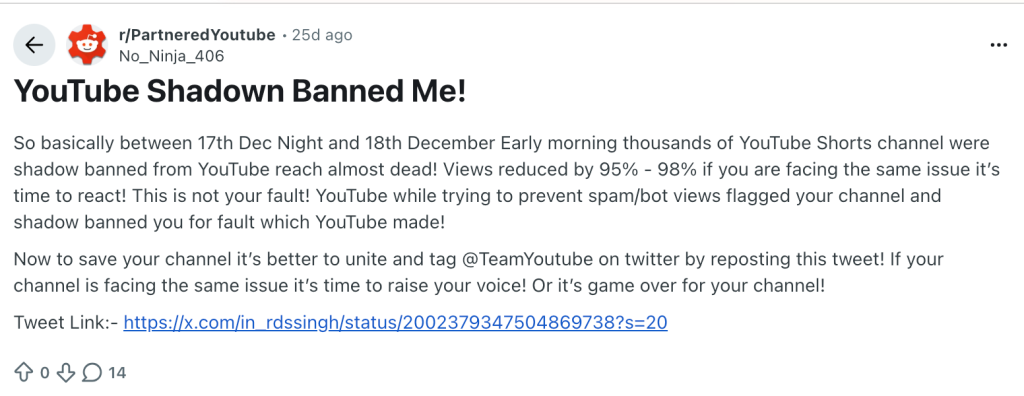
On YouTube, creators report seeing algorithmic flags that reduce reach. One recent post described Shorts views dropping by 95–98% overnight, suggesting the channel was “shadow-banned” and flagged by YouTube’s system during an anti-spam sweep.
@No_Ninja_406 says:“So basically between 17th Dec Night and 18th December Early morning thousands of YouTube Shorts channel were shadow banned from YouTube reach almost dead! Views reduced by 95%-98% if you are facing the same issue it’s time to react! This is not your fault! YouTube while trying to prevent spam/bot views flagged your channel and shadow banned you for fault which YouTube made!
Now to save your channel it’s better to unite and tag @TeamYoutube on twitter by reposting this tweet! If your channel is facing the same issue it’s time to raise your voice! Or it’s game over for your channel!”
Users in the thread were comparing notes on sudden visibility loss and advising patience while the platform system resets reach.
Instagram and flagged followers
A social media manager taking over an Instagram account with 8,000 followers discovered that nearly half were marked as suspected bots. Instagram suggested bulk removal. The concern was clear: keep inflated numbers or protect long-term reach. The case highlights how follower quality directly affects account trust.
@lunie2unz says:
“So I recently took over as a social media manager for this company. It looks like they bought followers in the past. We’re sitting at 8k followers but almost 4k have been flagged by Instagram as suspected bots.
Instagram is giving me the option to do a bulk removal of all of these bot accounts.
Is it a good idea to take the hit and just remove these followers? I worry if ignore this the account could be banned later on.
Also, if I do remove the followers, could my account actually be favoured more by the algorithm?”

Facebook and group posts marked as spam
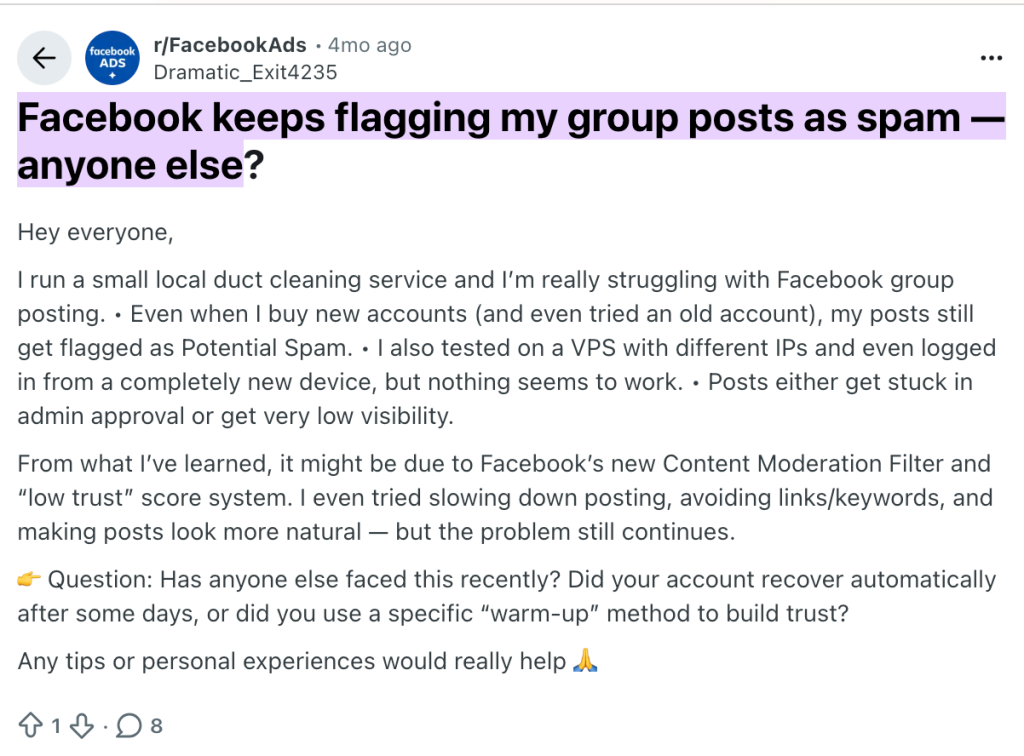
A local duct-cleaning business reported that Facebook repeatedly labeled its group posts as “Potential Spam,” even when posting from new devices and accounts. Posts required approval or received minimal reach. The owner suspected a damaged trust score and asked how to rebuild credibility—a good example of how automated filters can quietly limit small businesses.
@ADS Dramatic_Exit4235 says:
“Hey everyone,
I run a small local duct cleaning service and I’m really struggling with Facebook group posting. Even when I buy new accounts (and even tried an old account), my posts still get flagged as Potential Spam. I also tested on a VPS with different IPs and even logged in from a completely new device, but nothing seems to work. Posts either get stuck in admin approval or get very low visibility.
From what I’ve learned, it might be due to Facebook’s new Content Moderation Filter and “low trust” score system. I even tried slowing down posting, avoiding links/keywords, and making posts look more natural — but the problem still continues.
Question: Has anyone else faced this recently? Did your account recover automatically after some days, or did you use a specific “warm-up” method to build trust?
Any tips or personal experiences would really help.”
LinkedIn and account restrictions after minimal activity
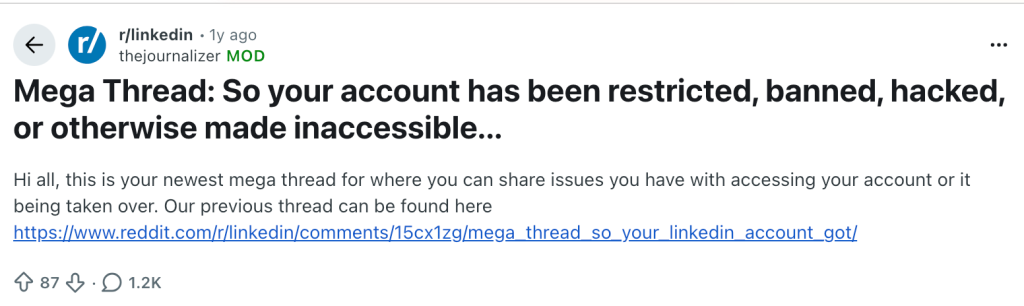
A Reddit thread about LinkedIn account issues shows how even new users can face unexpected restrictions or additional verification steps with little explanation. One user reported being logged out and then unable to complete identity verification because the platform flagged the account, suggesting that limits or review flags can trigger without clear policy feedback.
@thejournalizer says:
“Mega Thread: So your account has been restricted, banned, hacked, or otherwise made inaccessible…
Hi all, this is your newest mega thread for where you can share issues you have with accessing your account or it being taken over. Our previous thread can be found here.”
Consequences for businesses and creators
When links get flagged, the fallout is immediate and brutal. Reach drops first! Posts vanish from feeds, search results, and recommendations. CTR rates decline as users start to doubt unfamiliar URLs – they’re not taking that risk!
Repeated flags can slow growth for weeks and, in extreme cases, lead to permanent account restrictions or suspension. For brands and creators, the cost is lost visibility, delayed campaigns, and weakened audience trust.
How to avoid flags and fix flagged links
Use branded, secure links
Branded domains convey ownership and consistency. Ensure that links feature HTTPS encryption. Avoid lengthy tracking strings and unnecessary redirects. Regularly audit SSL certificates and monitor your domain’s reputation.
Avoid spammy posting
Space out your posts, rotate formats, and steer clear of duplicating content across accounts. Provide context around links instead of sharing URLs alone.
Limit automation (AI will kill your account)
Only automate legitimate tasks like scheduling. Avoid tools that promise rapid growth through engagement manipulation.
Build account credibility
Engage in meaningful conversations, respond to comments, and maintain consistent security settings. Verified profiles and two-factor authentication help minimize false flags.
Clean up audiences
Remove flagged followers or spammy interactions, especially on Instagram. Quality of your audience is more important than sheer numbers.
Appeal mistakes
Utilize platform review and appeal tools when content is mistakenly flagged. Human reviews frequently reverse false positives.
Social platforms flag links in a bid to protect users, but let’s be real: their automated systems are far from perfect. Domain reputation, security, posting patterns, and content quality all play a role in whether a link gets reviewed.
Brands that rely on secure, branded URLs and take the time to publish thoughtfully can actually reduce friction with these moderation systems. It’s not rocket science! By maintaining account credibility and employing clear link management along with disciplined posting habits, you can help ensure that your social media links remain visible and that your campaigns stay on track.
Ready to transform your link sharing? Discover the power of Cut0!
With Cut0, you can improve every step of your marketing funnel.
From attracting potential customers with clean, engaging links to nurturing leads with insightful analytics, our platform empowers you to optimize your strategies at every stage.
Monitor link performance, understand user behavior, and refine your campaigns to drive higher engagement resulting in conversions and sales.
So, are you ready to supercharge your marketing strategy with Cut0? Sign up for your free trial today!